Who owns what? A plain-English guide to owning a home in Ontario
Ask five people how they own their home and you may get six answers. Words like freehold, condo, POTL and joint tenancy get tossed around at closing tables and in group chats, usually when nobody has time to explain them. So here is the map, in plain English. If you are thinking about buying with other people, this is the ground you will be standing on.
Freehold
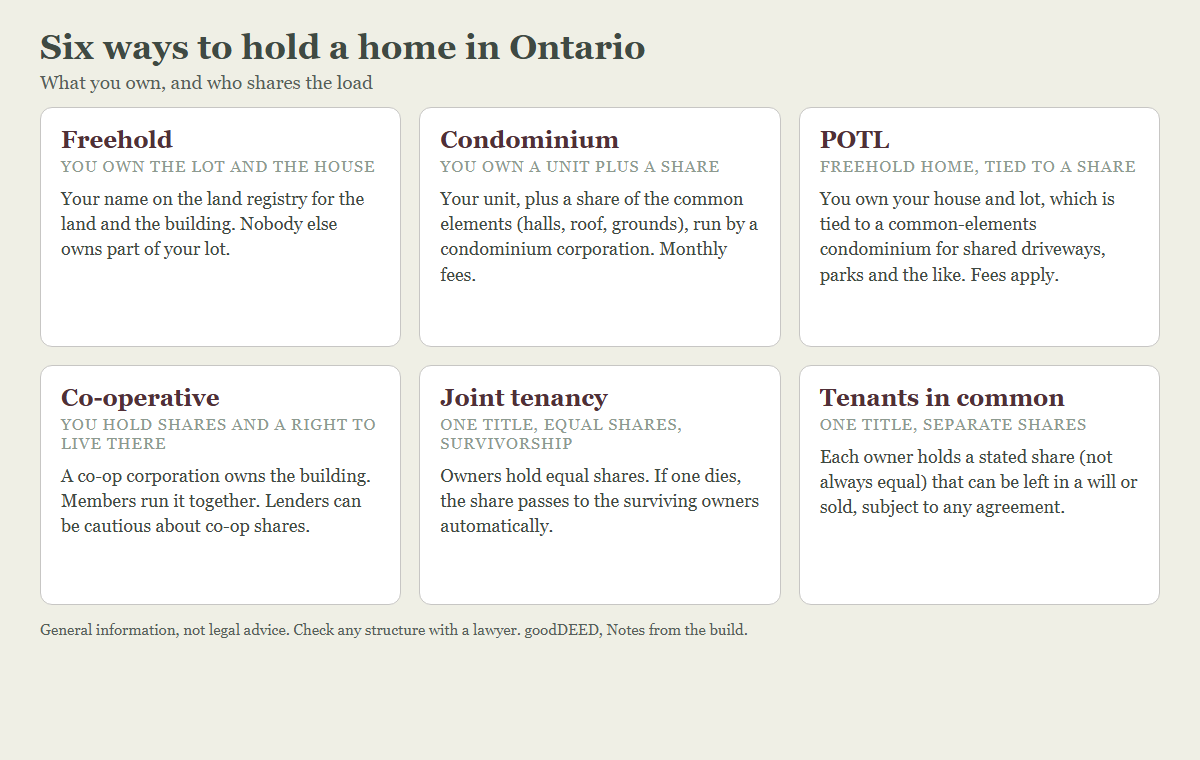
You own the land and the building, and your name is on the land registry for both. Think detached houses, semis and most row houses. It is the classic Canadian arrangement: you decide, you pay for everything, and nobody else owns a slice of your lot.
Condominium
In a condominium you own your unit, plus a share of the common elements: the hallways, roof, lobby and grounds. A condominium corporation looks after those, funded by monthly fees, and rules (the declaration and by-laws) set out how everyone lives. In Ontario this comes from the Condominium Act, 1998. Condos can be townhouses or even vacant land, not only towers.
POTL
POTL stands for parcel of tied land. You own your house and its lot outright (freehold), but your parcel is "tied" to a share of a common-elements condominium. That corporation looks after the shared bits, such as private roads, driveways, parks and visitor parking, and you pay monthly fees for it. You will see POTLs in many newer townhouse communities.
Co-operative
In a housing co-op, a co-operative corporation owns the building. You are a member with a right to live there, and the members run the place together. It is a strong model for community and steady housing costs, but your stake is shares and an occupancy right rather than a title to a unit, and lenders are often cautious about financing co-op shares.
Sharing one title: joint tenancy and tenants in common
These two describe how several people hold the same property. They are not types of building.
Joint tenancy: the owners hold equal shares with a right of survivorship. When one owner dies, that share passes to the surviving owners automatically, not through the will.
Tenants in common: each owner holds a stated share, equal or not (60/40, for example). A share can be sold or left in a will.
Neither one tells you what happens when someone loses a job, wants out, or stops getting along with the others. In most cases everyone on the mortgage is responsible for all of it, which is why a written co-ownership agreement matters. Have a lawyer draft it before anyone signs.
At a glance
Type | What you own | Who looks after shared things | Watch for |
|---|---|---|---|
Freehold | The land and the building | You | All upkeep and cost fall on you |
Condominium | Your unit plus a share of the common elements | The condominium corporation | Monthly fees, rules, special assessments |
POTL | Your house and lot, tied to a share of a common-elements condominium | The common-elements corporation | Monthly fees and shared-area rules |
Co-operative | Shares and a right to live there | The co-op's members | Lenders may be cautious; exit rules vary |
Joint tenancy | An equal share of one title | The owners together | Survivorship: a share passes to the other owners |
Tenants in common | A stated share of one title | The owners together | Needs a written agreement for exits |
Another route: buying through a corporation
Some groups form a corporation and have it buy the home, with the owners holding shares in the company. It can work, but it is a lot more complicated. You will usually need a lawyer and an accountant, the company has its own filings, taxes and costs, lenders may ask for personal guarantees, and the paperwork gets heavier every year.
There is a bigger catch for first-time buyers. A corporation is not entitled to first-time home buyer benefits. Those programs are for individuals buying a home, so a company holding title cannot claim them, and the people behind it can lose their chance to use them. That includes the First Home Savings Account (up to $40,000 of lifetime room), the Home Buyers' Plan (up to $60,000 from an RRSP), the first-time buyers' GST rebate on new homes (up to $50,000) and Ontario's land transfer tax refund (up to $4,000). For many first-time buyers, those are the difference between getting in and waiting.
The gap
Look at the list again. Every option on it was built for something else: one household on one lot, a building full of units, a street of townhouses, or a community that rents from itself. None of them was designed for a handful of households who each want to own a defined part of one property, with clear rules for who pays what, how decisions get made, and how someone leaves. So groups borrow the tool that almost fits, and a lawyer stitches the rest together with agreements, one group at a time, at some expense.
Why we need Co-DEED
We think Ontario can do better. Penn, who started goodDEED, calls the idea Co-DEED: a purpose-built way for several households to own together, where each household's share is clearly defined, and the rules for joining, deciding and leaving are built in. Written into the law, it would let lenders, lawyers and land registries all recognize it, so a group would not have to invent its own structure every time.
To be clear, Co-DEED does not exist in law today. In Canada, property law is mostly a provincial matter, so making it real means working with Ontario, and that takes lawyers, time and a lot of conversations. We are at the beginning, and we are saying so out loud.
What you can do now
If you are thinking of buying with others, write the rules down before anything is signed, and have a lawyer turn them into proper agreements. That is the part goodDEED helps with: we match compatible people and help a group work out the money, the rules and the design of one property together. Licensed professionals give the advice, and we coordinate.
Take our short questionnaire at gooddeed.ca/questionnaire, or see how it works at gooddeed.ca/find-a-partner.
Sources: Ontario Condominium Act, 1998 and O. Reg. 48/01 (common elements condominiums and parcels of tied land); Canada Revenue Agency, First Home Savings Account and Home Buyers' Plan; Finance Canada, first-time home buyers' GST rebate; Ontario Ministry of Finance, land transfer tax refunds for first-time homebuyers. This is general information, not legal, tax, mortgage or financial advice. Every group's situation is different, so speak to a lawyer and a tax professional before you decide.
